Songs
For example: “The Song That Came From Across the Ocean”

For the visits when you run out of things to say.
You are sitting next to him. The TV is still on. You have asked the three usual questions (How are you? Are you eating well? Did you see the doctor?) and it is a quarter to eleven.
You will leave in forty minutes feeling like you did nothing. And you will come back next Sunday to do it all over again. It isn't a question of time: you came. It isn't a question of love: you keep coming back. It's that you don't know what to do with that time.
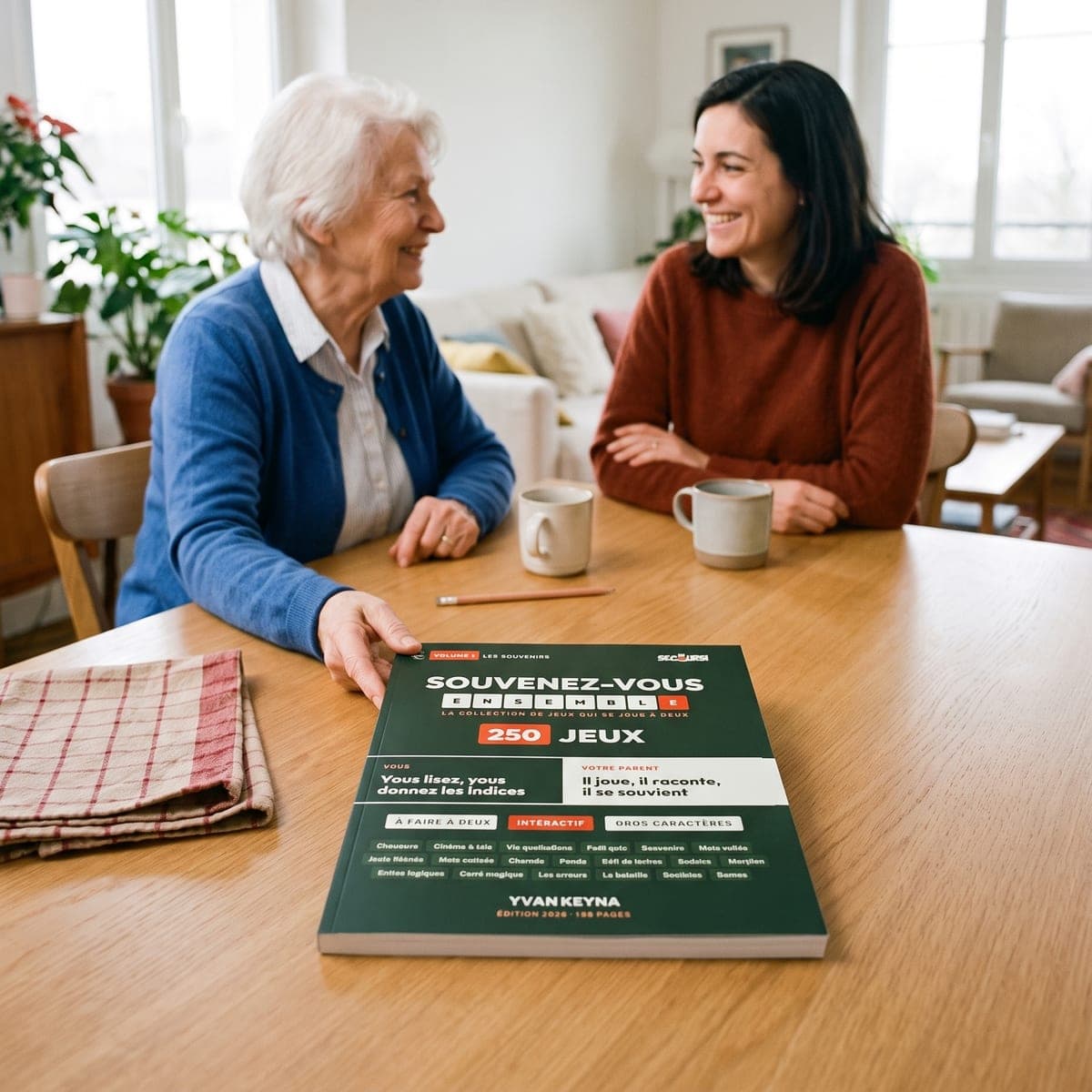
You open the book to the first page. You read the clue out loud. You give a hint, then another, and you stop as soon as the name comes back to him. And then something turns around.
The person you came to see becomes the one who knows again. He isn't sitting through an activity someone brought him: he holds the answers, because the songs he loved at twenty, the Saturday-night movies, and the everyday habits of the old days are his territory, not yours.
You are not keeping him busy. You are listening to him.
You arrive, you share the news, and after ten minutes the silence settles in.
You open the book to a page, you read out loud, and your parent searches for the answer.
The TV is on, you both watch it, and a whole visit goes by without talking.
One question from the book, and your parent is the one talking about being twenty.
You always ask the same questions: meals, sleep, the weather.
You ask which song was playing on the radio, and your parent hums it.
You talk about your week, your parent listens, and then no one knows what to add.
Your parent tells the stories, you listen, and you discover one you had never heard.
Your parent says they can't remember, and the conversation ends there.
The games give hints, and your parent finds the memory at their own pace.
You search for the song on your phone while your parent waits.
You take a picture of a small square, and the song starts playing for the two of you.
Someone who cares for your parent doesn't know what to suggest in the afternoon.
Someone who cares for your parent opens the book and gets them telling stories from the past.
You answer for your parent out of habit, and your parent lets you.
Your parent has the answer, not you, and your parent is the one who explains.
You leave with the week's news, nothing more.
You leave with a family story you didn't know the day before.
You wonder what to bring next time.
You leave the book on the table, and the next visit picks up on the next page.
| Without the book | With the book | |
|---|---|---|
| You arrive, you share the news, and after ten minutes the silence settles in. | You open the book to a page, you read out loud, and your parent searches for the answer. | |
| The TV is on, you both watch it, and a whole visit goes by without talking. | One question from the book, and your parent is the one talking about being twenty. | |
| You always ask the same questions: meals, sleep, the weather. | You ask which song was playing on the radio, and your parent hums it. | |
| You talk about your week, your parent listens, and then no one knows what to add. | Your parent tells the stories, you listen, and you discover one you had never heard. | |
| Your parent says they can't remember, and the conversation ends there. | The games give hints, and your parent finds the memory at their own pace. | |
| You search for the song on your phone while your parent waits. | You take a picture of a small square, and the song starts playing for the two of you. | |
| Someone who cares for your parent doesn't know what to suggest in the afternoon. | Someone who cares for your parent opens the book and gets them telling stories from the past. | |
| You answer for your parent out of habit, and your parent lets you. | Your parent has the answer, not you, and your parent is the one who explains. | |
| You leave with the week's news, nothing more. | You leave with a family story you didn't know the day before. | |
| You wonder what to bring next time. | You leave the book on the table, and the next visit picks up on the next page. |
In this aisle, everyone promises results. This book promises none. It brings memories back and gets people telling stories. That is already a lot, and you can see it for yourself from the very first visit.
As long as you remember together, you are still together.
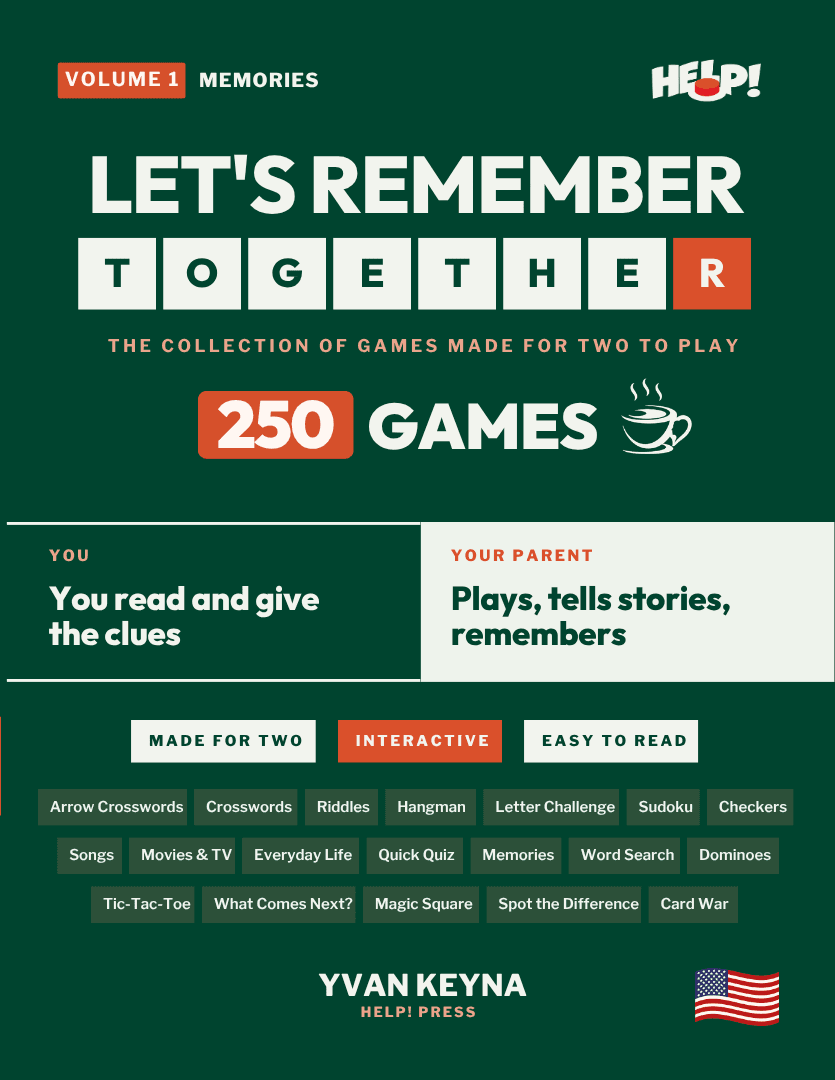
250 games in 19 categories. 125 games get your parent telling stories (songs, movies, everyday life), and each one comes with a video you open with a QR code, in the five categories below. The other 125 are for playing on paper: word searches, riddles, sudoku, spot the difference, the games everyone has always known and can still win.
For example: “The Song That Came From Across the Ocean”
For example: “The detective in the raincoat”
For example: “A nicely set table”
For example: “The dish that made eyes light up”
For example: “Your mother's hometown”
And 14 types of pencil-and-paper games: Word Search (games 126–137) · Arrow Crosswords (games 138–149) · Crosswords (games 150–158) · Riddles (games 159–167) · Hangman (games 168–175) · Letter Challenge (games 176–184) · Sudoku (games 185–197) · What Comes Next? (games 198–205) · Magic Square (games 206–213) · Spot the Difference (games 214–223) · Card Duel (games 224–231) · Dominoes (games 232–238) · Checkers (games 239–245) · Tic-Tac-Toe (games 246–250)
Early in 1964, one song seemed to play on every radio—in the kitchen, in the car, on the transistor under the pillow. On February 1, “I Want to Hold Your Hand” reached No. 1 in the country, the group’s first in America. A band from across the ocean had arrived, and by year’s end they had six No. 1 hits. Circle their name together.
See the page for game 1
Each QR code game has its own page: the instructions, then the video. Without the answer — that stays in the book.
For you, if you visit a parent, a spouse, someone you look after, and you are wondering what to do with that hour. Always for two: a son or daughter, a spouse, someone who cares for them. Your parent can also leaf through it alone between visits, but that is not what it was made for.
The book opens on the table, for two. It needs no screen, no account, no preparation.

Yvan Keyna is an entrepreneur, trainer and author. An entrepreneur for twenty years, with a master's-level degree in New Technologies and Sensory and Motor Disabilities (BAC+5), he runs Help! Press, a publishing house that will welcome several authors.
Learn more about himRetirement home or nursing home, home care service, local government, health insurer. Books in bulk for your residents, your clients or your teams.
Two books, two moments. Each one speaks to a different moment in what you are going through.
One Sunday, your parent tells you they fell last week. They're fine. They didn't want to say anything. And in that moment, you realize you have no idea what should happen next.
Leave your email: one message per book, nothing else.